Onsite Optimization: What to Fix Before Building Backlinks
By OnPageSEO.ai Team
Have you ever wondered why some websites rank quickly while others struggle even after earning quality links? Many brands jump into link building without fixing the basics, yet onsite optimization plays a bigger role in early ranking growth than most people realize.
When you improve onsite optimization, you strengthen your technical performance and increase your SEO impact before you ever earn a single backlink. This matters because a jump in page load time from one second to three seconds raises bounce probability by 32%, and organic search drives nearly 57.8% of global web traffic.
If your site cannot hold visitor attention or support search engine crawlers, backlinks will not deliver the results you expect. In this blog post, you will learn what to fix first so your pages load faster, your search marketing visibility improves, and even small business SEO tools work more effectively for your website.
Why Onsite Optimization Must Come Before Backlinks
Onsite optimization shapes how search engines interpret your pages long before they evaluate your backlinks. Search engines reward websites that offer clear structure, fast performance, and helpful content. If your onsite elements fall short, backlinks cannot compensate for weak technical signals.
A well-optimized site also improves search marketing visibility. When pages load quickly, provide mobile-friendly layouts, and demonstrate topical relevance, search engines gain confidence in your content. This raises your baseline ranking potential and allows incoming links to lift your authority more effectively.
Core Fixes Every Business Should Address
Before you invest in link outreach, evaluate the onsite elements that shape your website's performance. Strong onsite optimization establishes a foundation that supports faster loading, cleaner structure, and improved content clarity. These improvements increase your SEO impact and help search engines understand your pages with more accuracy.
When your technical setup, content, and on page elements work together, your site becomes easier to crawl and more compelling for users. This creates better search marketing visibility and prepares your pages to benefit from authority building efforts later on.
On-Site SEO Foundation Fixes
| Onsite Area | What to Fix | Why It Matters | Ideal Outcome | How It Helps SEO |
|---|---|---|---|---|
| Page Speed | Image compression, script optimization, server response time | Slow pages drive higher bounce rates | Faster loading and improved engagement | Search engines reward sites with strong performance signals |
| URL Structure | Consistent formatting, keyword relevance, readable structure | Confusing URLs weaken comprehension | Clean URLs that communicate clear topics | Better crawling and stronger topical signals |
| Indexing | Remove duplicate pages, fix blocked resources, submit updated sitemaps | Improper indexing wastes crawl budget | Search engines access every valuable page | More efficient crawling and improved ranking potential |
| Internal Links | Add contextual links, fix broken paths, balance link equity | Poor linking hides important content | A structure that guides users and crawlers | Better topic mapping and stronger authority distribution |
| Content Quality | Address search intent, add entities, include LSI topics, improve clarity | Thin or unclear content confuses search engines | Pages that satisfy user intent | Higher relevance and improved SEO impact |
| Title Tags and Meta Descriptions | Clear value, accurate targeting, compelling language | Weak metadata reduces click through rates | Search results that attract more visitors | Increased visibility and stronger engagement signals |
| Header Hierarchy | Logical H1 to H3 structure, keyword aligned topics | Disorganized headers reduce readability | Well structured outlines that guide readers | Better comprehension and improved ranking signals |
| Schema Markup | Apply article, product, FAQ, or organization schema | Missing schema limits rich result eligibility | Enhanced SERP appearance | Improved search marketing visibility |
| Compatibility With Tools | Ensure accuracy for small business SEO tools and audits | Poor formatting creates inconsistent results | Cleaner diagnostics and easier optimization | Faster improvements across the entire site |
When you improve these core areas, your website becomes more competitive even before you build a single backlink. Solid onsite optimization increases your authority signals, strengthens user engagement, and helps small business SEO tools read your content more accurately. By focusing on technical health, content clarity, and structural precision, you create a site that search engines trust and users enjoy. This foundation turns future backlinks into stronger ranking power and supports long term growth.
For a deeper dive on integrating keywords effectively to boost your SEO performance, check out how to use SEO optimization tools.
How Strong Onsite Optimization Improves Backlink ROI
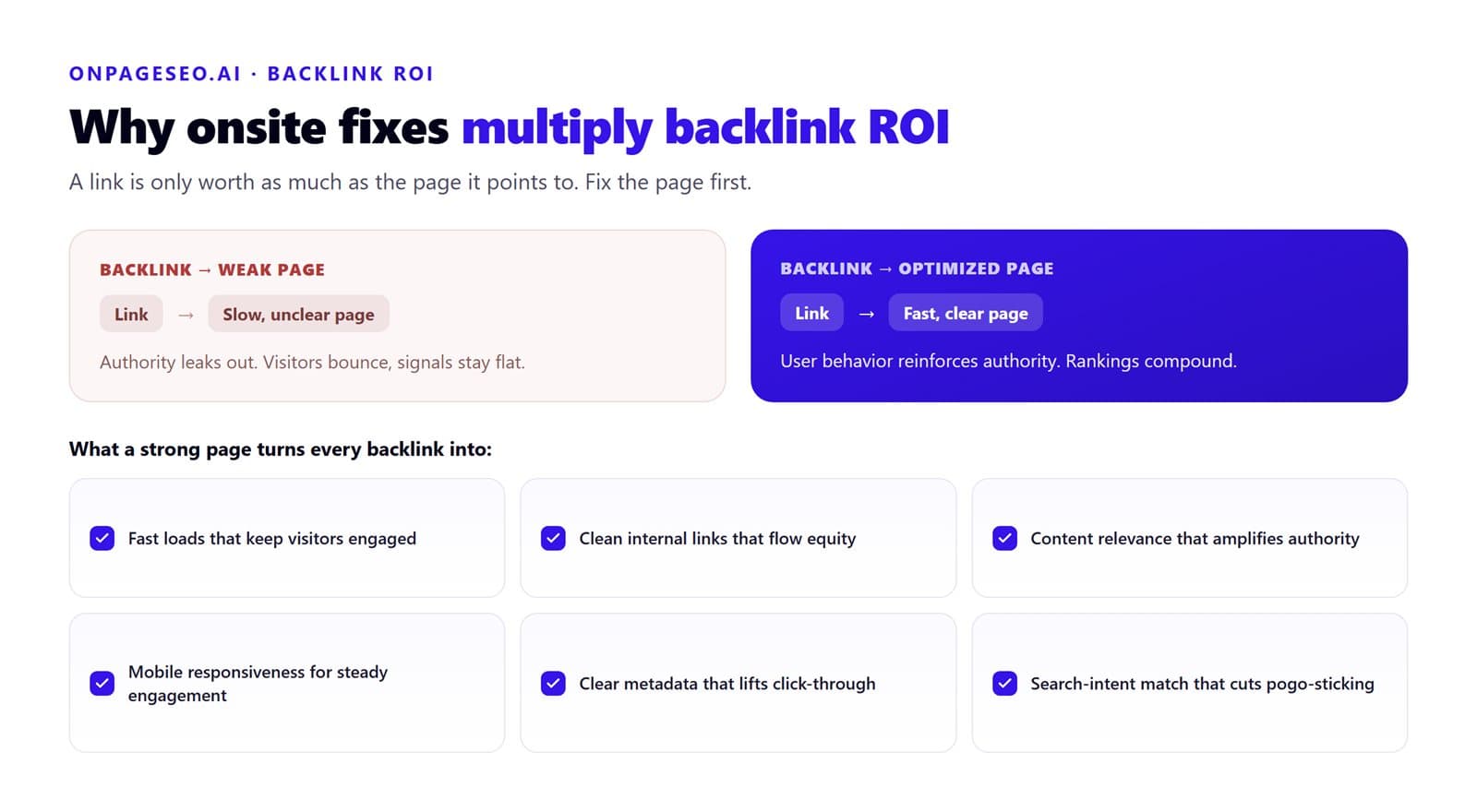
Backlinks strengthen your rankings only when search engines already view your site as trustworthy and easy to understand. Strong onsite optimization builds this trust by improving technical performance, content clarity, and structural organization. When your pages load quickly, follow clean architecture, and provide helpful information, search engines assign more value to every backlink you earn. This increases your authority signals and helps your website rise faster in competitive search results.
Key ways onsite optimization increases backlink ROI include:
- Faster loading pages that keep visitors engaged and reduce bounce rates
- Clean internal linking that helps link equity flow to important pages
- Strong content relevance that amplifies your topical authority
- Improved mobile responsiveness that helps maintain consistent engagement
- Clear metadata that increases click through rates from new visitors
- Better alignment with search intent that reduces pogo sticking
When backlinks point to pages that already perform well, user behavior reinforces your authority and strengthens your position in the rankings. Small businesses gain even more from this strategy because they rely on efficient spending and focused improvements. Strong onsite optimization ensures that every backlink drives measurable gains in visibility, traffic, and long term growth.
How OnPageSEO.ai Strengthens Your Onsite Optimization
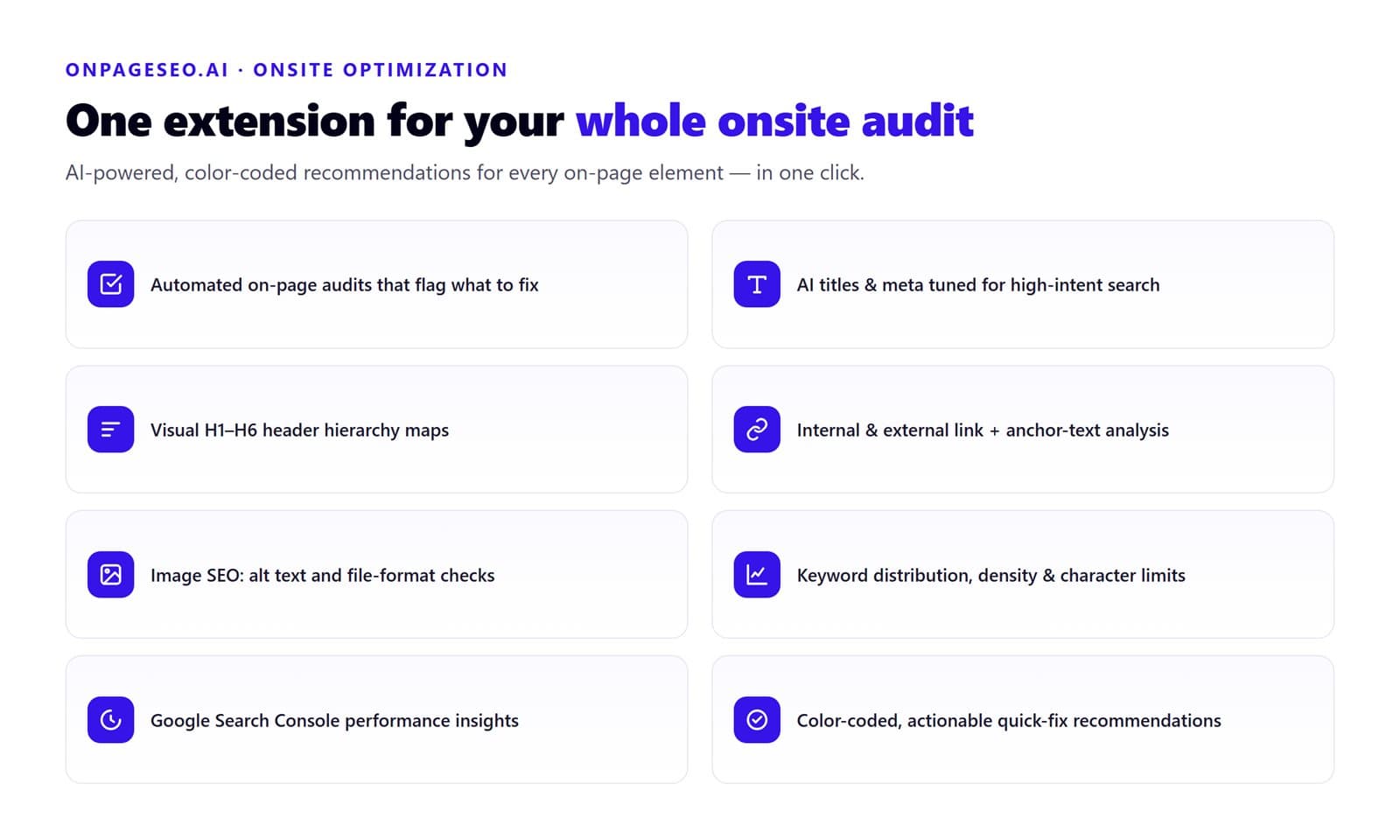
OnPageSEO.ai is an AI-powered tool that simplifies onsite optimization and enhances overall SEO performance. It analyzes key on-page elements such as titles, meta descriptions, header structures, internal and external links, and images, providing actionable insights to make content more search-engine friendly and user-focused.
Key capabilities include:
- Automated on-page audits highlighting areas for improvement
- AI-generated titles and meta descriptions optimized for high-intent searches
- Visual maps of header hierarchy (H1–H6) for better content structure
- Internal and external link analysis with anchor text recommendations
- Image SEO checks including alt text and file format suggestions
- Keyword usage tracking for distribution, density, and character limits
- Integration with Google Search Console for deeper performance insights
- Color-coded, actionable recommendations for quick fixes
These features help businesses optimize content faster, improve internal search relevance, and enhance user experience. AI-driven guidance ensures each page supports stronger onsite optimization, higher engagement, and improved search visibility.
FAQs on Onsite Optimization
What is onsite optimization?
Onsite optimization, also called on-page SEO, refers to improving the elements within your website to make it more search-engine friendly and user-focused. This includes optimizing page content, titles, meta descriptions, header tags, internal links, images, and overall site structure. Effective onsite optimization improves SEO impact, boosts search marketing visibility, and ensures users have a seamless browsing experience.
What is site optimization?
Site optimization is the process of enhancing both the technical and content aspects of a website to improve performance, usability, and search engine rankings. It covers areas like page speed, mobile responsiveness, navigation, internal linking, and keyword targeting. Site optimization helps search engines index your pages efficiently while making your site more engaging and accessible to visitors.
How to optimize your site for mobile?
To optimize your site for mobile, use a responsive design that adapts to different screen sizes, compress images for faster loading, and ensure text and buttons are easy to read and interact with on small screens. Minimize pop-ups, simplify navigation, and test pages regularly using mobile performance tools. Mobile-friendly sites improve user experience, reduce bounce rates, and increase search marketing visibility.
Final Thoughts on Onsite Optimization
Strong onsite optimization lays the groundwork for higher search rankings, better user experience, and more effective backlink strategies. From technical improvements like page speed and indexing to content clarity, header structure, and schema markup, each element contributes to your SEO impact and search marketing visibility. Evaluating and fixing these core areas ensures that every backlink, internal link, and keyword investment delivers maximum value.
The next step is to take action on these recommendations. Audit your site, address technical and content gaps, and structure your pages for both users and search engines. Using the right tools can make this process faster and more accurate.
For a streamlined approach, sign up for OnPageSEO.ai and install our Chrome extension. It provides AI-powered audits, actionable recommendations, and real-time optimization insights to strengthen your onsite SEO strategy. Get started here: Install OnPageSEO.ai Chrome Extension.