
A good SEO website becomes powerful when visitors can move through it with ease, but how often do businesses overlook the role of on site search optimization in that experience? Studies show that 30% of visitors rely on a website’s internal search, and these users are two to three times more likely to convert.
Sites that invest in on site search optimization often see a 10 to 15% lift in conversions, which directly supports stronger search engine positioning and overall performance. The problem is that many websites still treat internal search as a simple add on instead of a core usability feature.
In this blog post, you will discover how improving on site search optimization strengthens user journeys, boosts engagement signals, and helps you build a good SEO website that ranks and converts more effectively.
Understanding On Site Search and Its SEO Impact
On site search serves as an internal navigation system that lets users search content within your website. It reduceshttps://docs.google.com/document/d/1wURZvvPAw-2jpA61T9o5C2WJl2d44JdtQqW5s3AFUQk/edit?tab=t.0#heading=h.yn8zzjyeqgb0 friction and guides visitors to relevant information without making them browse through multiple menus. When internal search works well, users experience fewer dead ends and spend more time interacting with your pages.
This behavior sends valuable signals to search engines. Longer dwell time, higher click depth, and stronger user satisfaction contribute to improved search engine positioning. On site search optimization also supports better content discoverability by revealing which queries users perform inside your site. These insights guide content planning, internal linking strategies, and information architecture decisions.
Key Elements of On Site Search Optimization
Effective on site search optimization works best when every part of the internal search system supports clarity, accuracy, and relevance. Each element plays a role in shaping user experience and improving search engine positioning.
When your search tool understands content structure, user intent, and ranking signals, it becomes a strong driver of engagement and conversions. These foundations help build a good SEO website that satisfies both visitors and search engines.
| Element | Description |
| Relevant and indexed content | Your internal search engine should only index pages that offer value. This includes product pages, service pages, articles, and resource hubs. Exclude duplicate pages, test URLs, private dashboards, and thin content to avoid cluttered results. Use clear page titles, structured data, and well written headings so the search engine can understand content relationships and display accurate results. |
| Search intent coverage | Users search in different ways. Some type short keywords while others use full questions or conversational phrases. Your search system should understand these variations. It must detect synonyms, handle spelling mistakes, and process natural language queries to prevent zero result pages. This helps users find the right information even when their query is imperfect. |
| Faceted and filtered results | Filters help users narrow results quickly. Offer refinements such as price ranges, categories, tags, brands, locations, and content types. Faceted search makes it easier for visitors to explore options without returning to menus. This is especially important for ecommerce websites and large content libraries. |
| Smart ranking signals | Internal search results should appear in a logical order. Rank results based on relevance, popularity, freshness, and how closely they match user intent. A page that answers the query directly should appear first. Poor ranking frustrates visitors and lowers engagement, which affects overall search performance. |
| Analytics and behavior tracking | Your internal search is a source of valuable data. Search logs reveal common queries, new trends, content gaps, and the keywords users want but cannot find. This helps shape your SEO strategy, new content topics, site structure improvements, and user experience updates. Tracking behavior also highlights opportunities to improve rankings and conversions. |
Together, these elements create a search experience that feels intuitive and efficient. When users find what they need without friction, they stay longer, explore more, and engage at a deeper level. This supports your on site search optimization goals and strengthens your website’s overall performance.
Technical Implementation Best Practices
Technical execution determines how well your on site search optimization performs. Even if your content is strong, weak implementation can slow down discovery, frustrate users, and limit your ability to support strong search engine positioning. A good SEO website needs an internal search system that is fast, accurate, and structured in a way that aligns with both user behavior and search engine requirements. The following best practices outline the technical foundations needed to create a dependable internal search experience that improves engagement and strengthens overall site performance.
Enable autocomplete and prediction
Autocomplete plays a major role in guiding users toward the right content before they finish typing. Predictive search reduces errors and helps users refine their queries without extra effort. This feature is especially useful for ecommerce websites, news sites, and knowledge bases, where users might not know the exact wording of the page they need.
Autocomplete also prevents zero result pages by suggesting correct terms or related queries. It supports on site search optimization because it reveals popular queries and helps you understand what users genuinely want. These insights can improve content planning and internal linking.
Predictive search also reduces the impact of misspellings and long form questions, making the search journey smoother across all device types. By simplifying the search process, autocomplete strengthens overall usability and supports stronger engagement signals that contribute to improved search engine positioning.
Implement structured data
Structured data helps your internal search system interpret your content accurately. Schema markup clarifies the role of each page by identifying products, articles, FAQs, events, and other content types.
When your internal search engine understands these signals, it can provide richer and more precise results. This creates a smoother experience for users and reduces the time spent navigating through irrelevant pages. Implementing structured data also improves search quality by displaying important attributes directly in search results, such as product prices or article publication dates.
These enhancements help users decide which result matches their intent before clicking. Strong structured data also supports your broader SEO efforts because search engines reward clarity and well defined content.
Adding product schema, article schema, and FAQ schema establishes a clean data ecosystem that benefits both internal search and external indexing. This level of clarity helps build a more organized and trustworthy search environment.
Ensure mobile friendliness
Mobile navigation plays a major role in modern user behavior. Since a significant percentage of visitors use smartphones, your on site search must function flawlessly on smaller screens. Mobile users expect simple inputs, clear layouts, fast loading times, and results that adapt to their device.
A poorly optimized mobile search interface often leads to higher abandonment rates, especially if typing or scrolling feels difficult. To support mobile friendliness, search bars must remain visible and accessible on every page. Results should appear in clean lists with readable text and large tap targets. Predictive search and filters should load smoothly without forcing unnecessary steps.
Prioritizing mobile usability improves conversion paths and ensures that your internal search remains effective for all visitors. This level of optimization strengthens overall user engagement, which contributes to healthy search engine positioning and supports the standards required for a good SEO website.
Maintain clean URL structures
Clean URLs support both usability and internal search accuracy. Readable URLs help search tools categorize and index content correctly, which improves search relevance. Cluttered URLs containing random characters, multiple parameters, or tracking strings can confuse internal search systems and lead to inaccurate results. Clean URL structures make it easier for your search engine to map connections between related pages and retrieve the right content for user queries.
For users, readable URLs create a sense of trust and clarity when browsing through search results. This is especially important for sites with large content inventories, where structure and hierarchy matter. Maintaining clean URLs also supports analytics because it becomes easier to track which pages perform well and how users move through your site.
When URLs are structured and consistent, your internal search engine operates with more precision, helping strengthen the overall effectiveness of your on site search optimization strategy.
These practices work together to build a stable technical foundation that enhances performance, supports user engagement, and strengthens your entire search ecosystem. Discover affordable SEO tools that can elevate your on site search optimization and overall SEO strategy.
How OnPageSEO.ai Helps Strengthen Your On Site Search Strategy
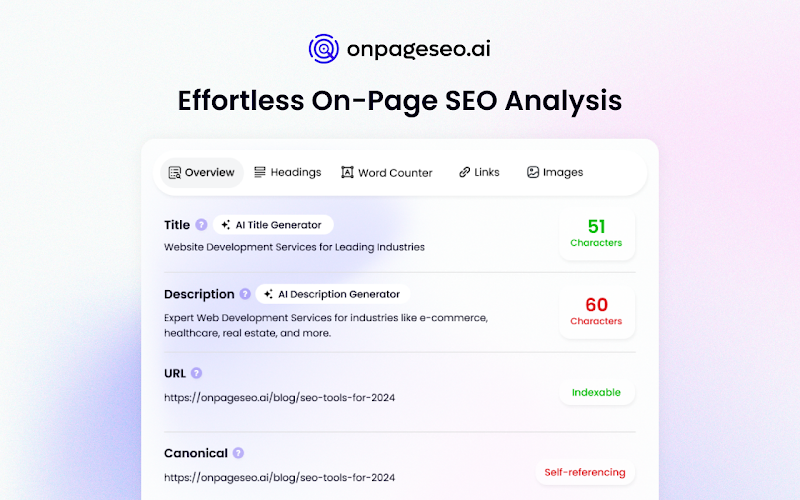
OnPageSEO.ai is an AI-powered Chrome extension that streamlines on site search optimization while improving overall SEO performance. The tool provides instant on-page audits, analyzing key elements like page titles, meta descriptions, header structures, internal and external links, and image SEO.
These insights help ensure that your content is structured and optimised to support search engine positioning and provide a seamless user experience, which is essential for a good SEO website.
- Instant on-page SEO audits for titles, meta descriptions, headers, and links
- AI-powered title and meta description generator for high intent pages
- Header structure audits (H1–H6) with interactive visual maps
- Internal and external link analysis with anchor text evaluation
- Image SEO audits including alt-text checks and WebP conversion suggestions
- Keyword analysis with distribution tracking, density percentages, and character counters
- Full Google Search Console insights for deeper optimisation (Pro plan)
- Color-coded recommendations for quick, actionable improvements
Using these features, OnPageSEO.ai helps SEO professionals optimize pages faster and more effectively. The tool identifies content gaps, improves internal search relevance, and enhances the user journey while ensuring accurate, easily discoverable results.
Its combination of AI-driven recommendations and comprehensive auditing tools strengthens your on site search optimization strategy, supports higher engagement, and improves search engine positioning.
To take your optimization further, explore practical guidance on adding keywords to your website to maximize SEO impact.
Final Thoughts on A Good SEO Website Starts With On Site Search Optimization
On site search optimization is a crucial component of a good SEO website. It improves user experience, increases engagement, and supports stronger search engine positioning by helping visitors find relevant content quickly. Throughout this guide, we’ve explored key elements like relevant content indexing, search intent coverage, faceted results, smart ranking signals, and technical best practices including structured data, mobile friendliness, and clean URLs.
To fully leverage these benefits, it’s essential to combine strategy with the right tools. OnPageSEO.ai provides AI-powered on-page audits, keyword insights, and optimization recommendations that make internal search more effective and your website more discoverable.
Take action today to boost your site’s performance. Sign up for OnPageSEO.ai and install the Chrome extension here to start optimizing your pages, streamline internal search, and strengthen your overall SEO strategy immediately.